Hello everyone,
I would like to share a thought about using a local, open-source suite of tools in design school.
This is a subject I’m directly concerned about, and I’d welcome your feedback.
Context
I used to teach interaction and software design at design schools in France, especially at the ECV and LISAA. For 5 years, I’ve taught Figma as my main tool because it is widely used in agencies and even large companies. The pedagogical team also asks lecturers to mainly focus on using Figma during our courses and workshops.
The problem
From an educational perspective, providing tools for free is mandatory because our students have already paid for their grade year, so it is inappropriate to ask them to pay for an ephemeral license for a single course. The school already provides Adobe because it negotiates a specific contract to provide licenses to every student. In the case of Figma, the educational license was really helpful for teaching several parts of our jobs and practicing them. Nevertheless, last year, the educational license became much harder for new students to get because the criteria changed and became stricter. These conditions also force schools to invest more in infrastructure to provide each student with a dedicated email address.
A second point concerns AI. As our role evolves rapidly, companies strongly require juniors to know how to use AI to build prototypes, analyze user data, automate workflows, etc. 3 years ago, companies required juniors to already be seniors because of the post-COVID crisis and limited HR budgets. Like the design tool, I don’t want my students to pay for a Claude license or ask the school to provide one for each student (I cannot imagine the billing at the end of the month).
A third point I’ve noticed during my courses is that the students do not trust AI, because they think “it is stealing” their perspective. The insight behind this is that the students use AI during their internship to generate junk content. So they don’t learn how AI can be a companion that helps them make decisions, rather than just executing design.
What I’m exploring
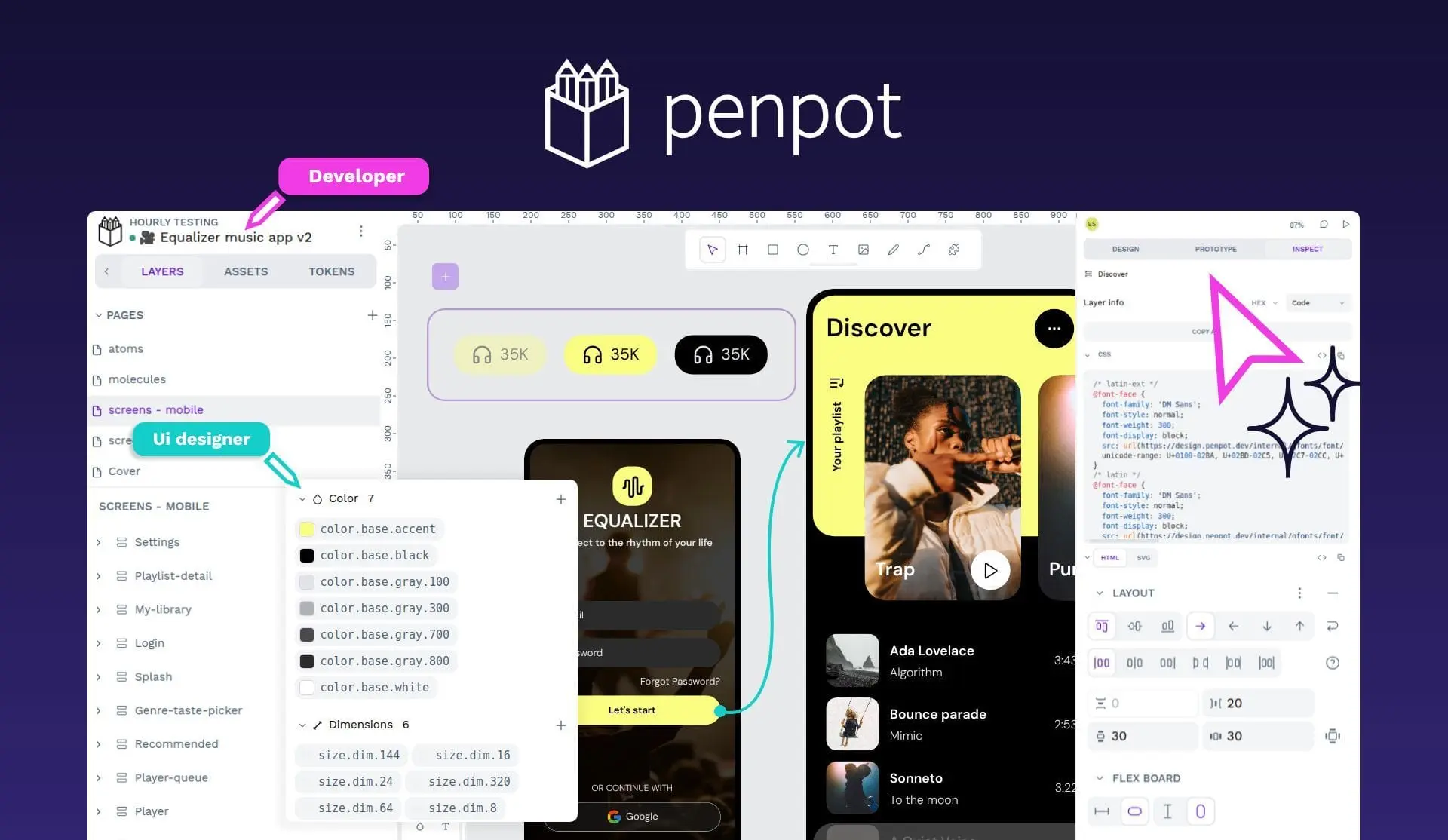
The AI wave cannot be escaped, and the design tool can make you enjoy it, but not freely. That is why I’m exploring alternatives that let my students practice and prepare for their near-future careers as juniors. Penpot is, for me, the main Figma alternative, perfectly suitable for schools and AI; nevertheless, getting a suitable alternative to Claude or ChatGPT is not a piece of cake.
AI is a large blue ocean with a ton of LLMs, clients, and infrastructure, but I want to test one in a broader protocol. If the condition is not paying for anything, local LLMs and open-source clients sound good.
Here is a schema to make this realistic:
- The student gets an open-source LLM client, such as AnythingLLM and OpenCode, to keep all the data (chats, sessions, contexts) on his local machine. He can download an LLM based on his available resources. AnythingLLM is a one-stop shop that may be more suitable for students who aren’t used to writing Bash commands.
- The lecturers (if there are several) can serve an LLM through
llama.cpp llama-server, by combining their computers to allocate more resources for large models. Otherwise, use a specific machine with good specs to serve via llama-server or AnythingLLM (which can serve through the LAN). While a student brings their own machine, we cannot know in advance whether they can download and run an LLM, even a smaller one. - The school can provide a server with sufficient specs to serve several LLMs according to the use case. This is the best option, but it can cost a lot if there is no convention nor rule. Besides, I first need to prove that a local LLM is better than spending money on Claude for educational licenses.
The reason why
This isn’t only about saving money; it’s also about sovereignty. This part is the politics one. Europe, including France, is energizing its own companies to use European solutions: French LLMs, open-source solutions, etc. Dependencies on the USA and China squeeze us between two blocs, even though the Internet should let everyone move at the same pace. France is transitioning its public services to Linux, so why don’t schools follow suit?
Some open questions
First of all, thank you for reading this ticket. What I’m exploring is an open letter, and nothing has been tested yet (very soon).
- If you have already set up an infrastructure to serve LLMs (at schools, in your company, etc), what challenges have you faced? (team/studients adoption, potential failures, confidence in your system)
- How can we help students be prepared despite limited design or AI tools?
- How can we make students confident in using LLMs?