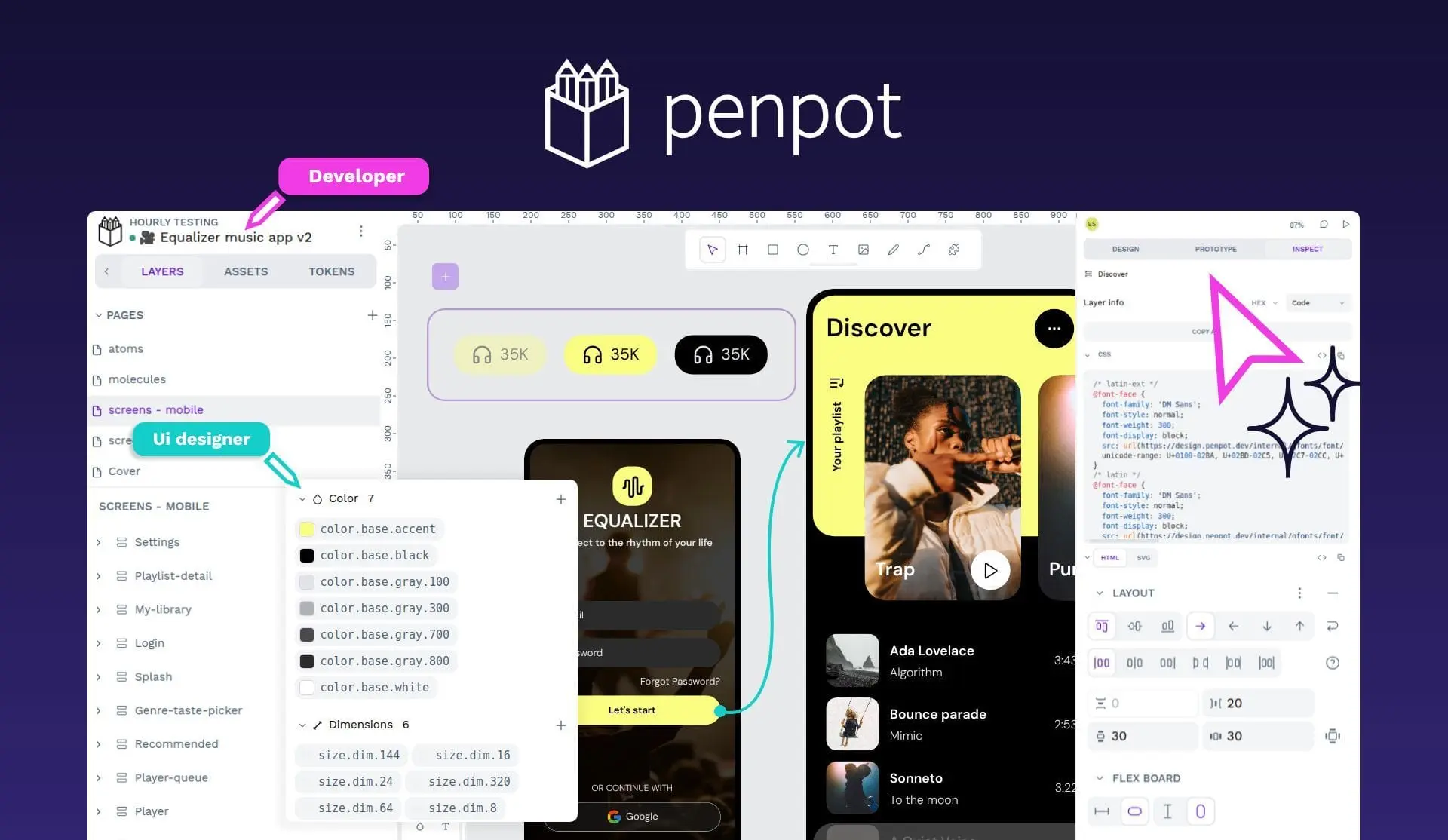
I’ve been working on a Skill that can recreate mobile app screenshots as editable designs in Penpot.
The idea is simple:
Screenshot → AI analysis → Penpot design
Instead of generating a flat image, the Skill reconstructs the interface directly in Penpot, so the resulting elements can be selected, edited, and reused.
What it can do
Analyze a mobile app screenshot
Reconstruct the UI structure and layout
Create editable elements directly in Penpot
Reproduce text, colors, spacing, borders, and other visual details
Turn an existing interface into a Penpot design that you can continue editing
The project is currently a Skill rather than a Penpot plugin. I’m still experimenting with the workflow and improving the reconstruction quality.
I’d love to hear what the Penpot community thinks about it — especially whether this workflow would be useful to you and what features you’d like to see next.
If there’s enough interest, I’d also like to explore turning it into a more integrated Penpot tool in the future.
That’s an interesting way of creating designs in Penpot. This might be useful if you migrate from older tools.
Do the skills cover the design tokens? That might be useful if you start from scratch.
By the way, are you affiliated with Tencent or something? I’m a bit curious about the design tools in such a big Chinese company, where Figma is partially excluded without a VPN.
Hi @a-ng-d, thanks! Design tokens are actually a really good suggestion — I hadn’t thought about that layer before.
I’m primarily a backend engineer, with relatively limited experience in frontend development and design. The original motivation behind this skill was pretty practical: in some of my full-stack projects, I wanted to reference classic, well-designed interfaces and use them as a starting point when building my own frontend pages. That’s what eventually led me to experiment with turning screenshots into editable Penpot designs.
As for Tencent, I did work there for about three years. From my experience, large tech companies tend to keep their internal workflows and tooling up to date. VPN/network access isn’t really a major obstacle for employees in that environment, so tools like Figma can be used when needed.
And thanks again for bringing up design tokens — I’ll definitely look into how they could fit into this skill.
@MrGood4U I wonder if Tencent employees use Penpot as a primary design tool because your screenshot made me curious about this topic. My point is totally off-topic because I studied the Chinese market to see what Chinese people use as a design tool. I discovered a lot of alternative tools because Figma is not really performant.
Once again, this angle is interesting for teams using different tools in order to test Penpot or migrate some user flows little by little.
Might be an interesting point to reproduce the user interaction. How a user can interact with a screen to produce a result.
for what it’s worth all the screenshots on Lolly Tools are all SVG because we built a rendering engine that can turn any URL into editable vectors and images (nicely grouped not insanely clipped)
That may help save some tokens in the asset creation process
In fact, the new employees of Tencent tend to use the design tools that are already in use within the team, especially if the design team needs to collaborate using these tools. Employees of large companies are less likely to demand that the team change the tools they are currently using. There are some exceptions to this rule: for instance, if the team leader wants to improve efficiency by changing the tools as part of their performance, they will have the motivation to push the entire team to make the change. Or if the team is basically being re-established, and the higher-ups do not want to spend too much on subscription fees for the team (in my opinion, Tencent tends to cover all infrastructure costs for employees, including but not limited to Adobe, Figma, Claude, etc. subscriptions. But Temu is completely different. The team there is extremely frugal, to the point where even the VPN requires employees to purchase it individually). Let’s cut to the chase. In fact, both large company teams and I probably decide which tools to use based on this idea: the ecosystem of the tool. Especially now that the era of AI agents is on the rise, many teams will value whether the AI agents can be integrated with the tools, because many Chinese internet giants have started to use whether they can use AI agents to improve employee efficiency as a mid-level assessment criterion. If you want to see more and more people using Penpot, I think it’s very important to do a good job with the ecosystem and keep up with the trend of AI agents.