5 years building
1.5M users worldwide
44K+ GitHub stars
A team of 44 people + collaborators
And a global community backing it, bringing key features, incredibly useful feedback, and mind-blowing initiatives.
Five years ago, Penpot officially launched to the public. Today, we celebrate that milestone.

What a story!
UXbox, the seed
Penpot was more than just a product innovation; it fundamentally shifted Kaleidos, the company behind it, at its core. From a services-driven business to a product-focused one. Exciting challenge!
At the time, design and code workflows were disconnected. Existing tools were proprietary, and none truly bridged the gap between designers and developers. There was no open-source alternative: we built it!
In 2015, the seed of what would later become Penpot was called UXbox.

As innovation needs time, space, and the arena to tinker and experiment, our PIWEEK (innovation weeks) gave us exactly that.
What started as an experiment gradually evolved from a side project into a product vision. The whole team focused on building Penpot around the principles that have always defined the team: open source, transparency, generosity, strong communication, and collaboration.
This is how Penpot emerged as the first open-source product design and development tool created to solve our own needs (needs that many developers and designers here were also experiencing) and built in the open from day one.
From idea to a globally enjoyed product
Behind every product journey, there’s early support that makes it possible. Penpot not only exceeded expectations but also made history in Spain.
Between 2022 and 2023, Penpot raised a total of $20M in funding, becoming the Spanish open-source company with the largest Series A investment to date. After launching publicly in 2021 and progressing from Alpha to Beta, Penpot gained public funding and growing adoption. It officially came out of Beta in January 2023, marking a new stage of product maturity.

In February 2023, Penpot had reached 250,000 users and over 20,000 GitHub stars, reflecting 500% growth and solidifying its position as a leading open-source design and development platform. The milestone was spotlighted by TechCrunch covering the round and highlighting Penpot’s rapid growth and its role in bridging design and development through open source.
Since then, growth has accelerated. GitHub stars entered an exponential curve and have continued on that trajectory.

Signups have followed the same pattern, reflecting sustained adoption and increasing momentum across the ecosystem.
Since 2024, Penpot has reached a new level of product maturity. The team evolved alongside the product, growing intentionally to support more use cases and scaling to handle multi-brand setups and organizations of any size.
“This is the best my eyes have seen in a long time”*
Penpot moved beyond being “just” a design tool and became a platform: an extensible, open, and collaborative foundation where design and code coexist, teams build shared systems, organizations manage multiple brands at scale, and contributors can extend functionality through open standards and community-driven innovation.
Were we heading the right way? We thought so, and the community kept reinforcing that feeling.

Each major feature marked a turning point, always built in the open and grounded in a declarative design approach, reinforcing transparency, and alignment between design and code.
- New Component System (Penpot 2.0): improved reusability, scalability, and consistency across design systems.
- Responsive Layouts with CSS Flex and Grid: it brought real CSS behavior into the design workflow, enabling more accurate and developer-friendly responsive layouts.
- Plugin System: custom functionality, third-party services via the API, tailor workflows… And a wave of amazing plugins that followed.
- Native Design Tokens (W3C-compliant): the only design tool with built-in tokens. Boom!
 Tokens in Penpot are deeply integrated into the design workflow and the underlying data model. This makes them one of the most practical implementations of tokens currently available in design tooling.
 - Variants: The ability to group related component states (such as size, style, or interaction states) into a single configurable component with clear properties, simplifying system management and reducing duplication.
- MCP Server: An open Model Context Protocol (MCP) that lets teams connect design and code like never before. It allows any trusted AI agent or LLM to interact with Penpot files and turn the canvas into a programmable space for experimentation, automation, and multidirectional workflows.

As the tool became more complete and complex, resources like this hands-on demo series keep helping everyone learn by doing and get the most out of Penpot.
Community contributions and the birth of the Ambassador Program
Penpot is built in the open and shaped alongside this community. 
Regular beta testing helps us build features that work for real production needs. And much of what makes Penpot possible also comes from the generosity of the community such as:
-
* New plugins have been released every month by the community since we launched the plugin system.
-
The Canonical team provided thoughtful and highly useful feedback on improvements to the Grid Layout user experience.
-
Dalai Felinto Head of Product at Blender worked on two great improvements: more reliable masks when updating components, and a smoother token import experience.
-
And many more contributors we spotlight in the Dev Diaries
To meet the people behind those contributions and create a space to keep learning around design, code, and open source, we celebrated Penpot Fest in 2023 and 2025. Contributors and community members from the leading open-source companies and organizations such as Blender, Godot, Fedora, GitLab, Open Source Design and Nextcloud joined us, alongside designers, engineers, design system teams, and open-source advocates from across Europe and beyond.

Together, the two events reinforced a shared vision: connecting design and code in the open, fostering cross-community collaboration, and strengthening the ecosystem around Open-Source product development.
That same goal, sharing open knowledge to shape the growth of the open-source design ecosystem, is behind the Ambassador Program we recently launched. The first ambassadors are already working on their plans. For instance, CGGE, the organization behind the Blender certification, is introducing the first official Penpot certification (yeehaw!).

What’s next?
What started as an internal experiment is now a mature, open platform used by teams across enterprises, public institutions, and open-source projects. From the beginning, Penpot was built around a conviction: design cannot be disconnected from code.
For years, most design tools have treated design and development as separate stages. Penpot took a different path, where design decisions are created with a clear understanding of how they translate into code.
This is possible thanks to a declarative and semantic approach to design, where interfaces are structured systems rather than just visual compositions. As @diacritica explains in his essay The missing ingredient in design tools: declarative design , semantic design allows tools to express what something is, not only what it looks like.
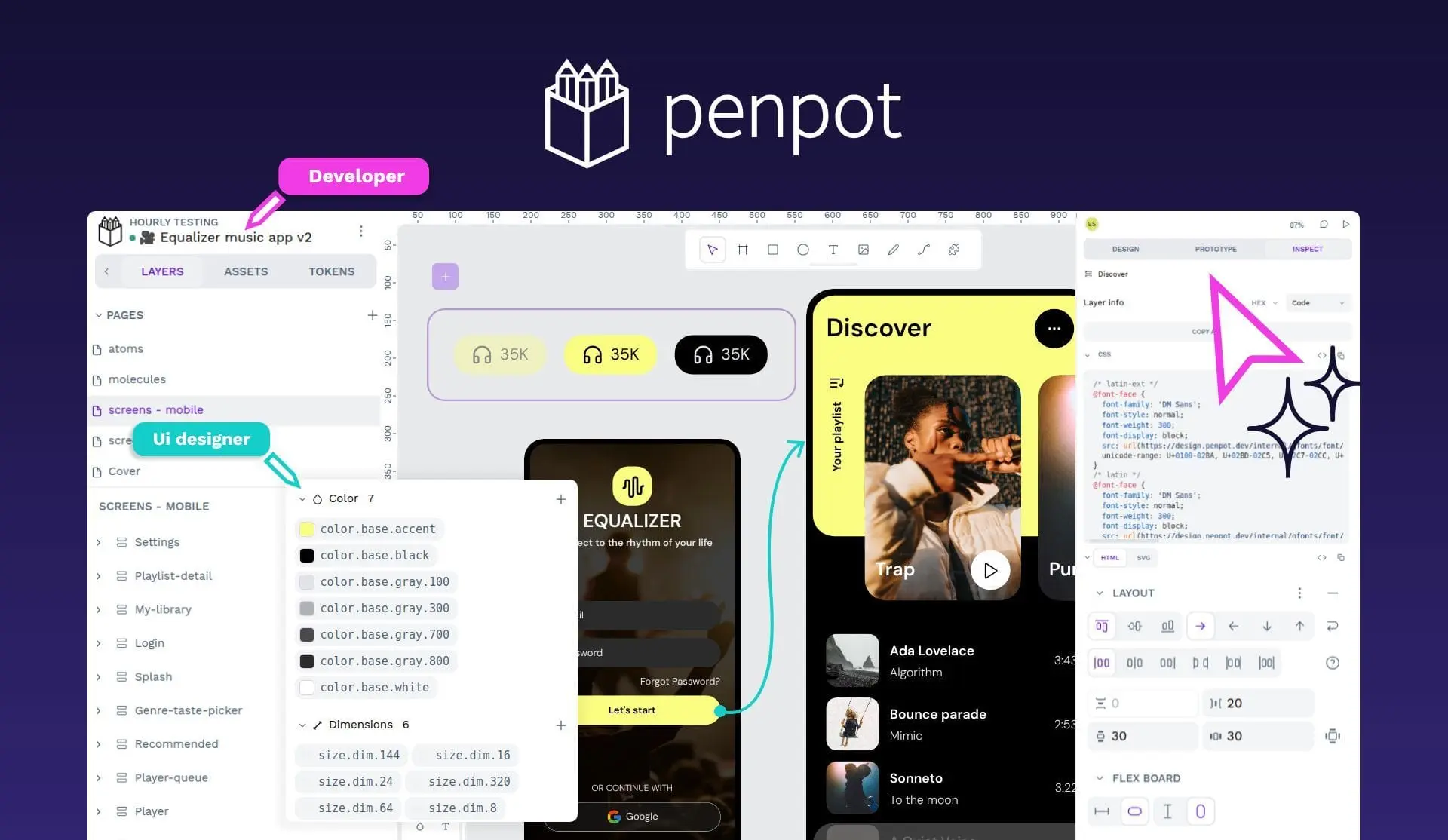
This approach naturally brings design and development closer together. Penpot reflects this philosophy with developer-friendly features like Inspect mode, which exposes CSS, HTML, and SVG, along with shared design tokens that act as a single source of truth between design and code. Built on open web standards and open formats, Penpot helps designers and developers collaborate using the same language. That’s why the idea of full-stack design is built into how Penpot works.
At the same time, the rise of AI and machine learning is reinforcing the importance of open and interoperable platforms. Systems that can connect, exchange data, and be understood by machines will shape the future of automated workflows and digital infrastructure.
Five years in and, with all this foundation already in place, Penpot is entering a new chapter, with the new MCP Server, a redesigned render engine (coming its way in a few weeks), and a new wave of capabilities on the horizon.
What’s next?
Whatever comes, and with Penpot being yours, we’ll shape it together.

* Kudos from the community Penpot Reviews & Community Feedback


 .
.